Skills Your Toddler NEEDS to Stop Biting at School
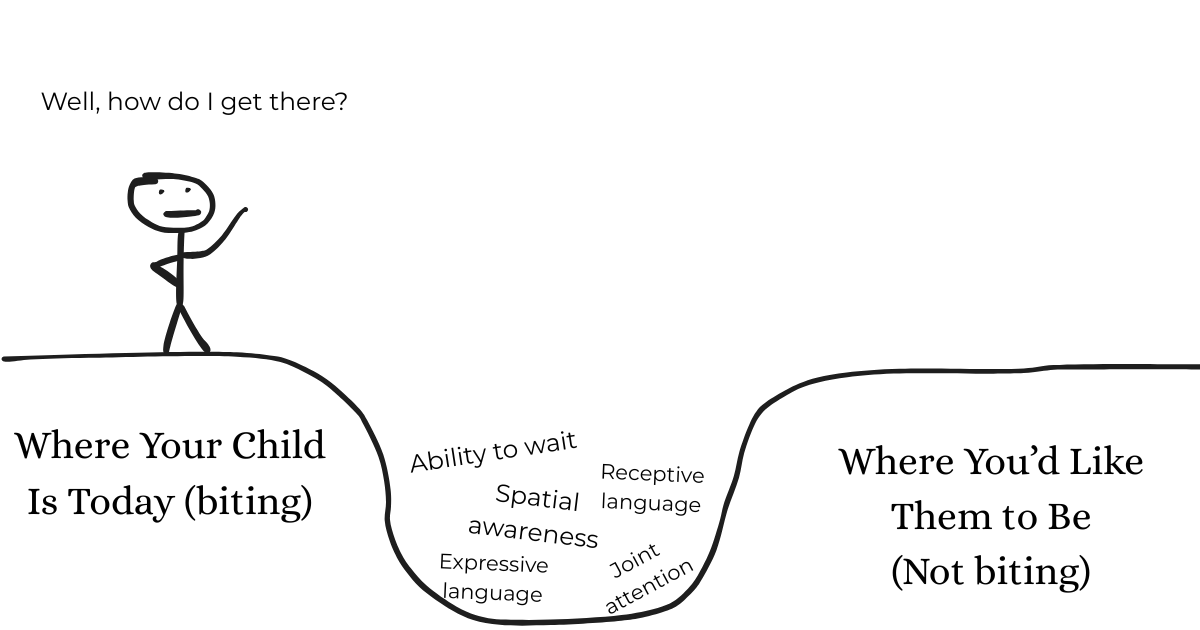
Your child isn’t bad - they have a skill gap
When we hear about a child biting, as adults, we have a tendency to react strongly. That's our adult lens coming to the forefront. We forget that toddlers have a worldview entirely their own. We talked about this in Biting In Daycare when I walked through our own methods of handling conflict.
As I mentioned then, toddlers have hundreds of skills they haven't yet mastered that we take for granted every single day. Even something as simple as getting a glass of water requires me to identify that I'm thirsty, recognize I need water, create a mental plan, sequence it correctly, get up, walk across the room, get a glass, turn on the faucet, fill it, and stand there drinking it with one hand.
Young toddlers can rarely do even one of those things independently. By two and a half they're likely trying… but it's shaky.
When it comes to sharing a toy, wanting to connect when lonely, or managing the pain of teething (all wrapped in frustration they can neither identify nor express) biting is bound to happen in a group setting. It's not a character flaw, but it is a predictable outcome of a known skill gap in a high-demand classroom environment.
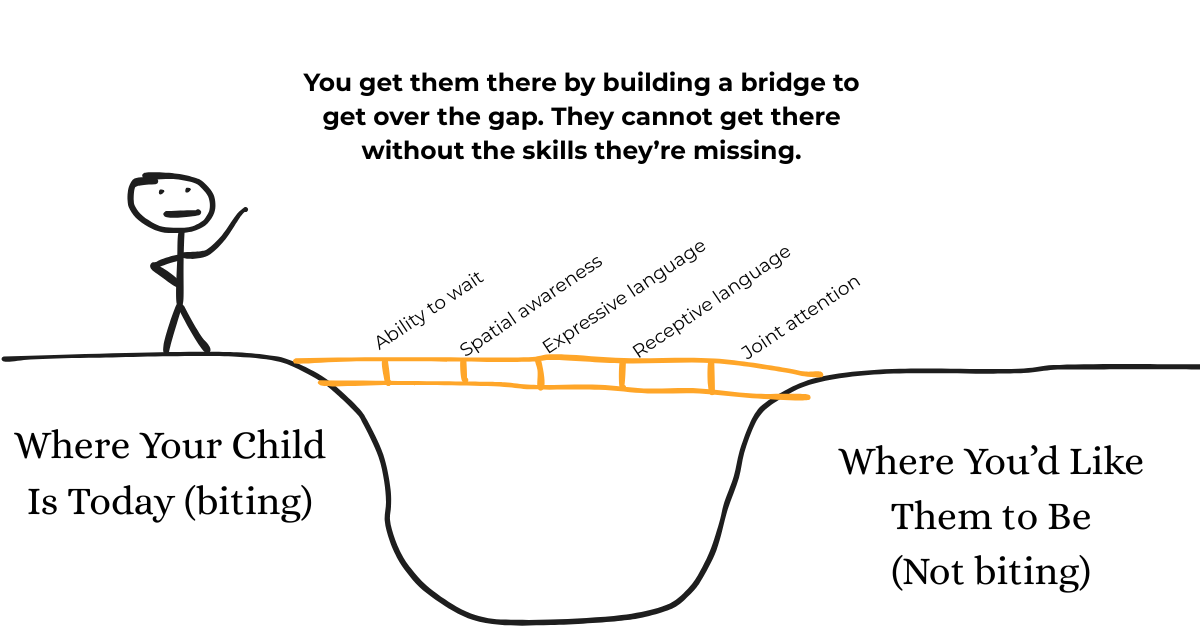
The best way to decrease biting is to identify what's missing and start teaching it. Figuring out the function of the behavior is the perfect place to start,this quick read will walk you through that.
Here are the most common skill gaps I see driving biting in toddlers and what you can do about them at home.
Joint AttentionThe ability to share an experience with another person.
You can often see this when a child uses a three-point-gaze*, looking at you, back to an object, and then back to you again. That back-and-forth look is a child saying "are you seeing what I'm seeing?" It's one of the earliest and most fun forms of real social connection.
(Imagine this skill and how often we use it as adults, staring at your cousin during dinner like Did Grandma really just say that?!)
When joint attention is lacking, a toddler has a harder time recognizing that another person is involved. This makes grabbing, pushing, and biting much more likely. Neither child is ignoring the other on purpose. They just haven't fully learned that other people are part of the equation yet.
Practice this at home: Hold a snack or a favorite toy just out of reach and wait, pretend to be distracted. Don't hand it over until your child looks up at or towards you. When they do, say warmly "Oh sorry! Here you go!" You're not withholding to be mean, you're creating a natural moment where they have to acknowledge you to get what they want. Do this often and casually throughout the day. It builds the foundation for noticing other people before acting.
*Three-point-gaze: when you say "I love your drawing" and your child looks up at you, back down at the drawing, and then back up at you again. That little triangle of eye contact is joint attention in action.
Spatial AwarenessUnderstanding where your body is in relation to the space and people around you.
Toddlers are notoriously bad at this, and it's completely developmental. They have no idea they're sneezing in your face, squishing a friend at the sink, or that their elbow is in their sibling’s back while they snuggle. Their nervous system is still learning to map their body in space, which means they frequently end up closer to other kids than anyone is comfortable with.
In a busy childcare classroom, poor spatial awareness creates constant collisions and collisions in toddler world often end in biting.
Practice this at home: Play games that build body awareness in a fun, low-stakes way. Simon Says is a classic for a reason, it asks kids to think about and control specific body parts on purpose. Obstacle courses using couch cushions and pillows, dancing with scarves, or even rough and tumble play with a trusted adult all help a toddler's brain learn where their body begins and ends. The more input their body gets, the better it maps.
Expressive LanguageThe ability to use words, sounds, or gestures to communicate a want, need, or feeling.
This is the big one. If a toddler could say "Stop, I don't like that" or "I want a turn" or "I'm frustrated right now,” the bite would be unnecessary.
Expressive language is the alternative behavior we're always looking for. The problem is it has to exist before it can be used.
Many toddlers who bite frequently are also toddlers who are slightly behind on expressive language, not alarmingly so, just enough that the gap between what they feel and what they can say is wide enough for biting to fill it.
Practice this at home: Narrate everything. "You look frustrated. You want the red cup, not the orange one." You're doing two things at once, naming the feeling and modeling the words for it. Over time, those words become available to them. Create opportunities for them to request things rather than anticipating every need. If you know they want more milk, pause and wait. Give them a chance to ask, even if it's just reaching toward the cup or saying "muh." That's expressive language!
Waiting and Frustration ToleranceThe ability to pause, tolerate discomfort, and trust that the need will eventually be met.
Waiting is genuinely one of the hardest skills for a toddler (and anyone with ADHD!) and one of the most demanded in group childcare. Wait for your turn. Wait for lunch. Wait for the bathroom. Wait for a teacher to finish helping someone else. For a child who lives entirely in the present moment and has no real concept of time, waiting feels less like a pause and more like a permanent loss.
Biting is often the result of a child who has hit the end of their waiting bandwidth and has no other tools available.
Practice this at home: At home, as parents, we often reinforce instant gratification - “Oh, you want a snack. Here you go!” because we have the ability, it keeps us moving forward, and your child stays happy. But at school, that’s not the case.
Build in small, intentional waiting moments throughout the day, not as punishment, but as practice. "Give me just a second!" while you finish what you're doing before handing them their Spiderman gummies. Count out loud together while you wait for something. Celebrate the wait when it's over , “You waited! That was hard and you did it!" Keep the waits short and successful at first. Start with just a few seconds at a time and build.
Receptive LanguageThe ability to hear, process, and understand what someone else is communicating.
Receptive language is the other side of the communication coin. A child might have words to express themselves but struggle to understand what's being said to them, especially in a noisy classroom with many voices, transitions happening, and a competition for their attention.
When a toddler doesn't fully process "That's his toy, please give it back,” they're not defying you. They may have genuinely not understood - remember, they’re still learning their first language. And when they reach for the toy anyway and get pushed or grabbed by the other child, a bite can follow quickly.
Practice this at home: Give one instruction at a time. When possible get on their level before you say it. Keep it short and concrete. "Shoes on" lands better than "Can you please go find your shoes and put them on your feet because we're leaving soon?" After giving an instruction, give them time to process. I often recommend a full ten seconds. Do your best to resist the urge to repeat it immediately, that actually resets the clock and they have to start over.
One Last Thing.
Not a single one of these skills is going to develop overnight, none of them develop without practice, and that will often mean life is harder for a while. Your toddler is not going to wake up tomorrow with frustration tolerance because you counted to five together at breakfast before his bite of waffle. But every single repetition is a deposit is a rep in the workout of real life - how to interact with others and build meaningful relationships.
Toddlers are never bad, they’re learning.