Why Toddlers Bite in Daycare
Think back to a time you were in line for a long-anticipated event. A concert with your favorite artist headlining (Brad Paisley's Water Tour in 2010), the finale to your favorite book-turned-movie series (Harry Potter anyone?), or the opening of a restaurant in town, the new CAVA in Polaris comes to mind.

Waiting in line for something exciting can be exhausting more than anything.
It's crowded, people are pushing on you.
You're tired of waiting and it feels like time is dragging.
It's loud, overwhelming, and what was supposed to be fun is now stressing you out.
Someone bumps into you and you're caught off guard, nearly falling over.
Emotions are high so you spin around, grab them by the arm and bite down.
No, you don't.
Because you're an adult with regulation skills like frustration tolerance and restraint. You know what is appropriate depending on the setting and you can scroll through the behavior options in your head and decide what fits the moment in a millisecond. You can do this because you spent decades learning these social rules without even realizing it.
So what do you do when that person bumps you?
You look to see what happened.
You determine whether you're safe.
You assess the people close to you and whether you know them.
If you know them, maybe you jokingly push back. If you don't, you give them a look as they apologize.
Both of you are aware that a social boundary was just crossed.
You take a step back and resume waiting.
Navigating that moment (in under three seconds without thinking) requires hundreds of skills, including:
Joint attention
Spatial awareness
Expressive language
A comprehensive vocabulary
Articulation
Perspective taking
Receptive language
Full control of your body
An understanding of time
Toddlers do not have these skills. But we forget that when we talk about biting.
Let's go through one of the most common biting scenarios I see in childcare classrooms.
Lunch is prepared, set on the table, and the children can see it. It feels like years have passed since breakfast three hours ago. They rush towards the sandwiches but are stopped, hands need to be washed first.
Frustrated, they all now run to the sink and are told they have to take turns.
A gaggle of dinosaur t-shirts and sundresses buzz, standing too close to each other, too close to the sink. Nobody can wash their hands because of how densely they're packed. A dino shirt reaches for the faucet at the exact moment a sundress does.
Suddenly there's screaming, shoving, and one grabs the other.
CHOMP.
Suddenly everyone is upset and a teacher quickly detangles the children, dries all the tears and finishes the washing cycle. Ushering them to the tiny table, she notices the mark.
You know who doesn’t notice the mark?
Any of the children. Even the one who was bit.
Within 30 seconds the bite is forgotten as they move towards the next part of their day.
Here's the thing: that bite was communication. It was the only tool available in that moment. Bites in toddlers can mean:
"Get out of my space!"
"That's my toy!"
"I need a teacher over here!"
"My teeth hurt!"
They have learned that biting is the quickest way to solve a problem. Because they do not have any other way to solve it yet. They have what we’d call a skill gap.
I hear parents say, "But it's traumatizing!" or "That can't be normal behavior!"
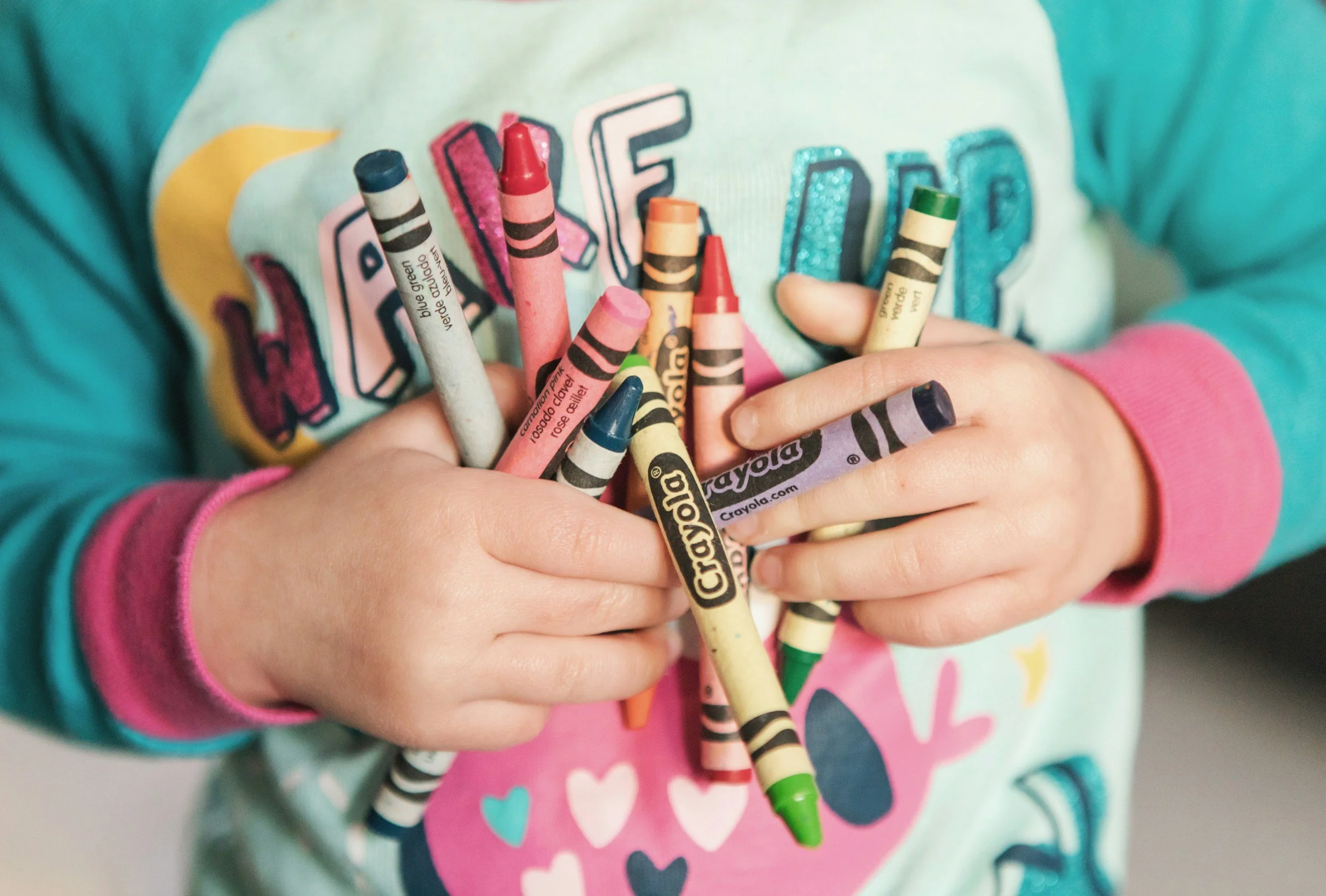
Hoarding resources like crayons is another common toddler behavior - due to the inability to take perspective and understand sharing is necessary.
Let me offer a new view. Here's a snapshot of a morning in my own toddler son's life, this is his “normal:”
He wakes up in his own poop
He has no idea what time it is or what the day holds
He falls over putting his pants on
He blows spit bubbles at himself in the mirror
He crawls under the table to retrieve a disgusting piece of last night's dinner
He shrieks when the dog barks and immediately starts crying
He climbs on the couch and jumps off approximately 1,634,972 times
He sprints outside, falls, scrapes his knee, gets up, and keeps running
He gets in the car for school
This is all before 8am.
Normal for toddlers is not normal for adults. They might as well live on a different planet.
So the next time you see a fading bite mark and feel panic rising, take a breath. It doesn't mean your child is being targeted or terrified of her peers. It doesn't mean something is wrong with the classroom and you should pull your spot immediately. It means they are, in every way, a toddler. Spending their days navigating stressful social situations with the tools they currently have.
The best news? We can give them much better tools to move them along from this phase. That's exactly what we're going to talk about next.
Up next: What's actually causing the bite, and why figuring that out helps so much.