What IS Natural Environment Teaching?
A Tiny Bites article: Quick answers on questions you’re actually asking.
Sarah Welsh, MEd, BCBA, COBA, TVI
Tiny Bites | Vol. 2
There are so many approaches out there - it’s smart to be hesitant and ask yourself what is this one about?
Q: What is Natural Environment Teaching, and why do you use it instead of sitting kids at a table?
Let me start by saying, I'm not anti-table. I know tables have their place and desks exist for a reason. But when I’m talking about toddlers and preschoolers, children whose entire identity and development is built to play, sitting them down for structured drills is working against the way they’re actually built to learn.
I’ll explain what I use and why - because once I started this method, there was no going back.
What is Natural Environment Teaching?
Natural Environment Teaching (NET) is an evidence-based method within Applied Behavior Analysis (ABA) that teaches skills inside moments where those skills actually happen. Rather than structured, clinical settings, NET focuses on helping children learn in real-world, natural contexts, emphasizing learning through play-based experiences, daily routines, and interactions with people and objects in the child's actual environment.
In simple terms: the classroom is the curriculum.
Snack time is a language lesson.
The block corner is a turn-taking lesson.
The playground is a problem-solving lesson.
No time is wasted.
This isn't a new idea, it originated with Betty Hart and Todd Ridley’s studies on language development in the 70s and continues to show promising results. Peer-reviewed research consistently supports NET's effectiveness, showing improvements in communication, play, and adaptive behaviors across a variety of natural environments. I use it with every child in my programs, not just those with a diagnosis. Because developmentally, it works for all of them.
Why play? Because that's where toddlers actually live.
Maria Montessori, a renowned child educator, famously said “Play is the work of the child.”
We forget that toddlers aren’t miniature adults, they don't learn by sitting still and being told things. They learn through doing, touching, experimenting, failing, and trying again. Play isn't a break from learning, it is the learning.
NET is an evidence-based teaching method that focuses on letting the child take the lead while learning new skills in an environment they are familiar with. This matters because a child who feels safe, interested, and in control of their experience is a child who is actually absorbing what's happening around them.
When I walk into a classroom and see a child building a tower with blocks, I don't see playtime - I see an opportunity to work on counting, on requesting help, on frustration tolerance when the tower falls, and on celebrating when it doesn't. All of that without a single worksheet or even direct instruction from me.
What does it actually look like?
It looks like going into the child’s world rather than pulling them out of it.
NET looks like a teacher getting down on the floor, following a child's lead — noticing what they're drawn to and using that as the entry point for a skill.
It looks like a child asking for "more" crackers at snack, practicing a real communication skill in a real moment where it matters to them.
It looks like sorting puzzle pieces and noticing one is missing and using spatial awareness skills to search for and retrieve the piece from under a chair.
Because it occurs in natural settings, NET is ideal for teaching real-life behaviors like asking for help, sharing, and following multi-step instructions. And crucially, kids actually use what they learn. When a skill is taught in the moment it's needed, it lasts longer.
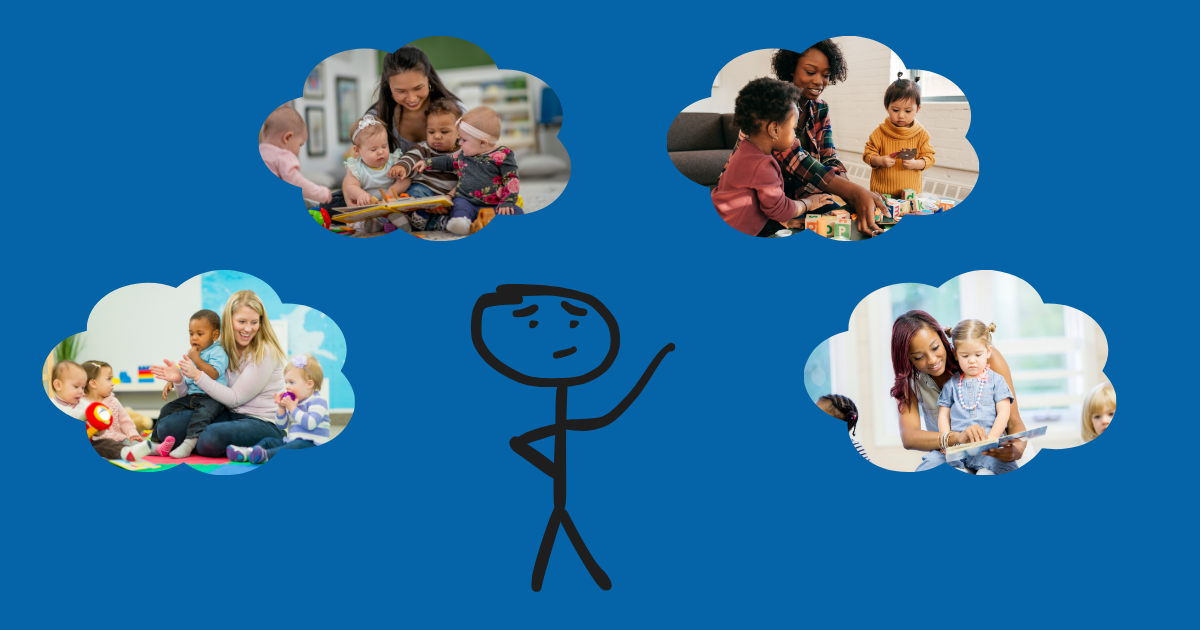
NET is all about the adults embedding themselves and the learning into the child’s interests and play.
So why not just use tables?
I'm not saying structured learning has no place. But for this age group, for toddlers and preschoolers who are still figuring out how to exist in a group, manage their bodies, and communicate their needs, setting them into a chair and expecting them to stay put and do as they’re told isn't teaching. It's compliance training.
The goal isn't a “well-behaved” classroom, sitting perfectly still in a line with “quiet hands and a bubble in their mouth.” The goal is a room full of children who know how to ask for what they need, handle disappointment, engage with peers, and feel confident in their own ability to figure things out. You can't drill that into a two-year-old, but you can absolutely build it, one playful, intentional moment at a time.
That's what Natural Environment Teaching is and that's why I use it.