Stop the Power Struggles
Tiny Bites | Vol. 5
Q: Why does everything feel like a power struggle with my kid/student?
You’ve probably said it. Maybe you’ve heard it from a teacher, or a parent at pickup, or your own exhausted inner monologue at the end of a long day.
“It’s a constant power struggle. They just won’t do what I ask.”
I hear this every single day. And every single time, I ask the same question back:
“What do you mean? What won’t they do?”
“Everything. All day. They’re defiant and rude and I am exhausted.”
And then I ask the question that usually stops people cold:
“How much are you asking them to do? How many demands are you making — and how many moments of genuine connection are you offering in between?”
That’s usually where the conversation gets uncomfortable. Because when we actually map it out, most little learners in group care settings are receiving dozens of demands for every single moment of warmth, play, or connection. And then we’re shocked when they push back.
First, let’s talk about what “defiance” actually is.
Toddlers and preschoolers are not defiant because they want to make your life difficult. They are defiant because they are developmentally wired to assert autonomy. Saying “no” is not a character flaw in your three-year-old, it’s a milestone. It means their brain is doing exactly what it’s supposed to do.
In the world of Applied Behavior Analysis — the science of behavior — we look at why a behavior is happening before we try to change it. And when we look at defiance in little learners, what we typically find is this: the behavior is working. Saying no, refusing, melting down, it’s getting them something they want. Control. Attention. Escape from a demand they didn’t want in the first place.
The behavior isn’t the problem - the behavior is information. We can take that information and do something with it, or we can continue pretending it’s happening “randomly.”
The tug-of-war nobody is winning
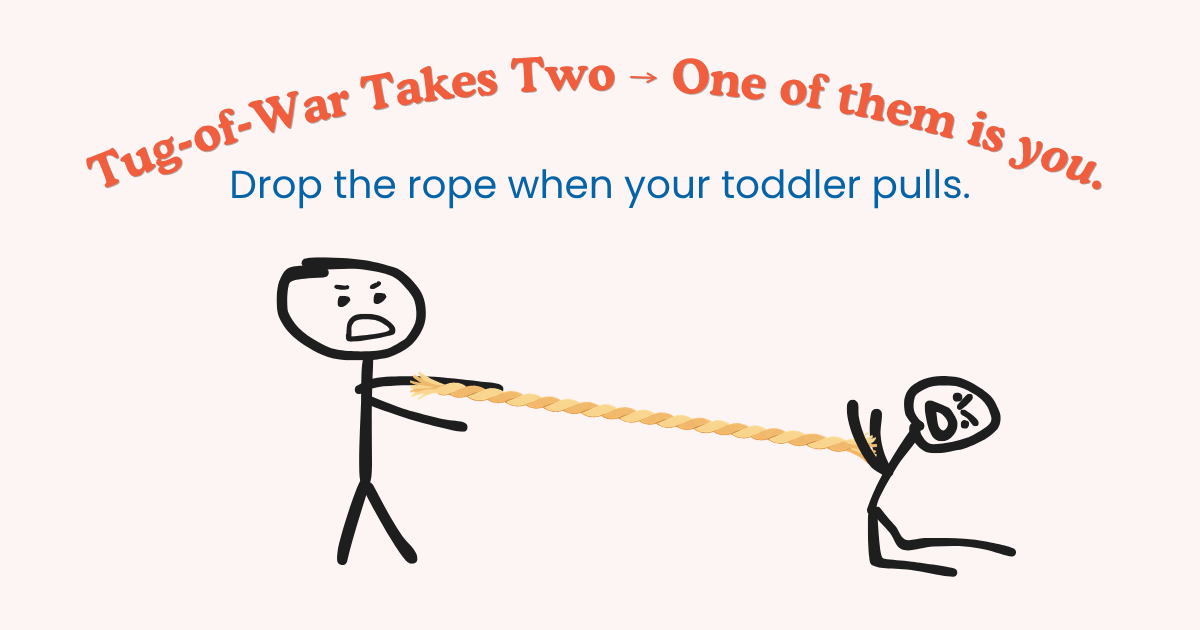
Here’s the image I want you to hold onto: a tug-of-war rope. On one end, you. On the other end, a four-year-old who has been told what to do seventeen times before lunch.
Every time you escalate — louder voice, bigger consequence, more rigid demand — they pull harder. Every time they pull harder, you escalate more. And around you go, both of you exhausted, neither of you getting what you actually want.
Here’s the thing about tug-of-war: you can’t play it with someone who won’t tug back.
Drop the rope.
Not because the child wins. Not because limits don’t matter. But because the moment you stop pulling, the entire dynamic collapses. There’s nothing left to fight. And into that space — that quiet moment after the struggle — connection becomes possible again.
What’s actually driving the power struggle?
In behavior analysis, we talk about something called the demand to reinforcement ratio, basically, how many times are you asking something of a child versus how many times you’re giving them something positive, connecting, or fun?
Research in ABA consistently supports what’s called behavior momentum — the idea that little learners are far more likely to comply with difficult requests when they’ve had a string of easy, successful interactions first. In other words: get an easy yes before you ask for the hard thing.
When a child’s day is built almost entirely on adult-directed demands — line up, sit down, don’t touch that, use your words, stop running, share that — and those demands are rarely balanced with genuine connection, play, or choice, the child reads the adult as a signal for stress. Not safety, stress.
And a stressed response looks a lot like defiance.
What to do instead:
This isn’t about letting little learners run the classroom or the household. Structure matters. Limits matter. What we’re talking about is how you build the relationship that makes those limits land.
CHECK YOUR RATIO. For every demand you make, are you offering moments of connection? A smile, genuine play, a silly joke, following their lead, noticing what they’re doing and commenting on it — not correcting it. If your interactions are mostly corrections and directives, you’re working against yourself.
Offer choices within structure. “Do you want to clean up the blocks first or the crayons first?” Both options are acceptable. The child gets autonomy but you still get the outcome. Nobody loses.
Build momentum before the hard ask. Need them to transition to something they totally hate? Start with two or three things they’ll easily say yes to. “Can you hand me that book? What’s that character on the cover? We love Spiderman, don’t we? Let’s put it away. Now it’s time to clean up.” You’ve primed their brain for compliance to that request.
Stop negotiating during the meltdown. When a child is in the middle of a meltdown, their brain is not available for reason. This is not the moment to explain consequences or renegotiate terms. Stay calm and close, but say less. Wait for the storm to pass and then have the conversation.
Drop. The. Rope. When you feel the tug, when the power struggle is escalating and you can feel yourself getting pulled in — consciously disengage. Not in defeat, as a strategy. Walk away from the dynamic unfolding, not the child. “I’m going to give you a minute” is not giving up, it’s often your best bet at getting through it.
The bottom line
Power struggles are a two-person game. And you — the adult in the room — are the only one who can choose not to play.
That doesn’t mean you’re weak. It means you understand something the child doesn’t yet: that connection is more powerful than control. That a child who feels safe with you will do hard things for you. That the goal was never to win the tug-of-war — it was to make the rope unnecessary in the first place.
Little learners are not your opponents. They’re just small people who haven’t learned yet how to ask for what they need without a fight.
Your job is to teach them there’s another way and it starts the moment you drop the rope.