Tolerating Frustration is a Skill
Tiny Bites | Vol. 4
Q: My toddler completely falls apart when things don't go their way. Is this just their personality?
No, it’s not. Frustration tolerance isn't something your child either has or doesn't. It's a skill. And like every other skill (sharing, waiting, asking for help) it has to be taught. The good news is you can teach it, but the complicated part of this is that a lot of what we do out of love is getting in the way of this skill.
What is “frustration tolerance”?
Frustration tolerance is the ability to stay regulated (keep functioning) when something is hard, uncomfortable, or not going your way. For a toddler, that might look like trying to put on their shoe three times before asking for help, waiting for a turn with the sink, or not getting the Spidey cup. These moments feel small to us, to a two-year-old, they are earth-shattering.
Toddlers are not wired to handle frustration gracefully. Their prefrontal cortex, the part of the brain that manages impulse control and emotional regulation, won't be fully developed until their mid-twenties. Some level of falling apart is completely developmentally appropriate., and we're not trying to eliminate frustration. We're trying to build the capacity to move through it.
Why group care (daycare!) makes this urgent
If your child is home with a parent or grandparent who can attend to their every need immediately, frustration tolerance develops slowly. They’re used to near-instant gratification from their caregiver. But the moment you put that child in a group care setting, a daycare, a preschool, a classroom with twelve other kids, everything accelerates out of need.
In group care, your child will have to wait. They will not always get the teacher's attention when they want it. Another child will have the toy they want , they will lose at games. And they will experience scarcity of attention, of materials, of preferred activities, every single day.
Group care is, by design, a frustration tolerance workout. And if your child hasn't been building that muscle at home, the classroom becomes a pressure cooker.
The thing we accidentally do that makes it worse
I am about to be so real with you, please know this comes from a place of love and it's incredibly common.
When we see our child struggle, when their sweet face crumples, they whine, they can't figure it out — our instinct is to fix whatever it is. And we do it immediately. We hand them the toy they're reaching for before they have to ask. We open the container before they've tried. We skip the hard part because watching them struggle feels awful.
What we're teaching them, however unintentional, is: you can't handle this. So I'll handle it for you.
This is what psychologist Martin Seligman called learned helplessness, a state in which individuals believe they have no control over the outcomes of their experiences. Research tells us that some children show a helpless pattern of cognitions, emotions, and behaviors as early as preschool, meaning we could be accidentally wiring this into them very early. And once a child believes they're incapable of figuring things out, they stop trying. They wait for someone to rescue them instead. EBSCOVocoVision
Learned Helplessness is not a personality trait, it's a learned pattern. It can be unlearned, but it's a lot easier not to teach it in the first place.
What building frustration tolerance looks like every day:
It's less about what you do and more about what you don't do. Here's the practical version:
Let them wait. Not forever, but a scooch longer than feels comfortable. When your child wants something and you're available to give it, pause. Let them sit for a moment. That pause is a rep in the workout.
Let them try. New toy, new food, new skill, before you jump in to demonstrate or help, give them a minute to figure it out. Even if they don't get it. (Especially if they don't get it!)
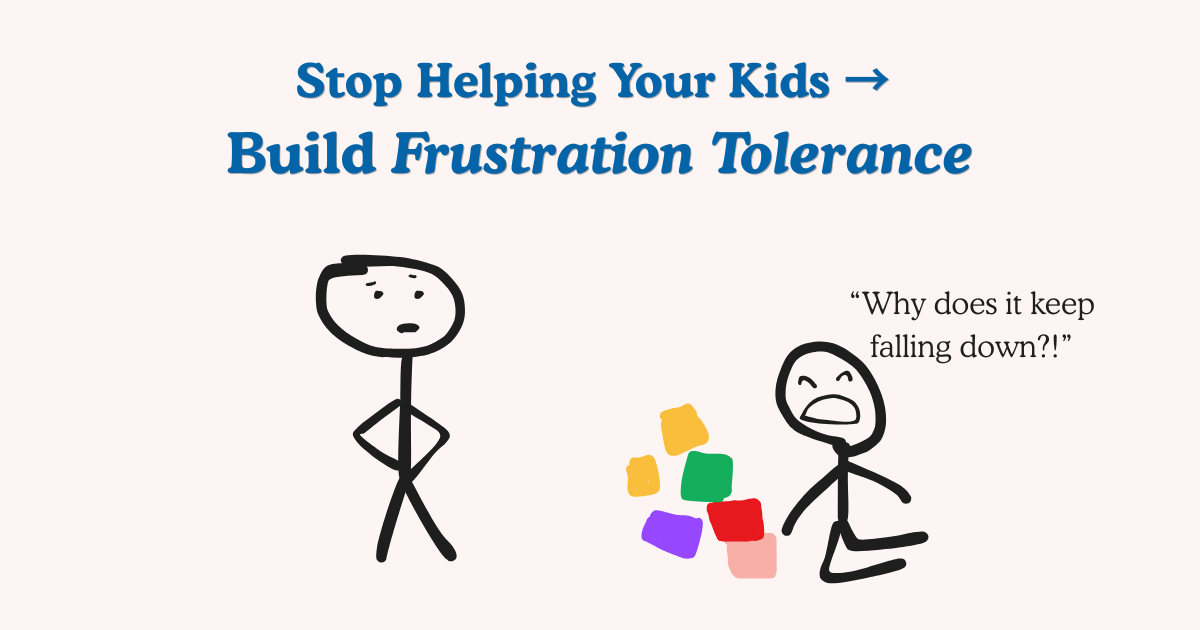
Stay close but don't swoop in and fix it. Your presence is the regulation support they need. You don't have to fix the problem to communicate safety. You can sit nearby, say "I see you working on that. You got it.'“
Let them fail small. A toddler who drops their cracker and cries about it is practicing. Later, a toddler who drops their cracker and picks it back up and keeps going has built a skill. You can't just skip practice rounds and expect the skill to show up.
Name the feeling, not the solution. "You're frustrated because the puzzle isn't working" is more useful than handing them the piece. If you want to step in, offer an idea without fixing it outright. Model regulation through breathing and narrating what’s going on around them.
The bottom line
Frustration tolerance is not a fixed trait your child was born with or without. It’s a skill built through thousands of small moments of being allowed to struggle, wait, try, and keep going, with a safe adult nearby who believes they can do it.
Every time you resist the urge to swoop in, you are handing your child something more valuable than the solution to their immediate problem. You're handing them the experience of figuring it out themselves.
That's what they'll carry into the classroom and into the rest of their life.
Learn more:VocoVision — Helping Children Overcome Learned Helplessness